

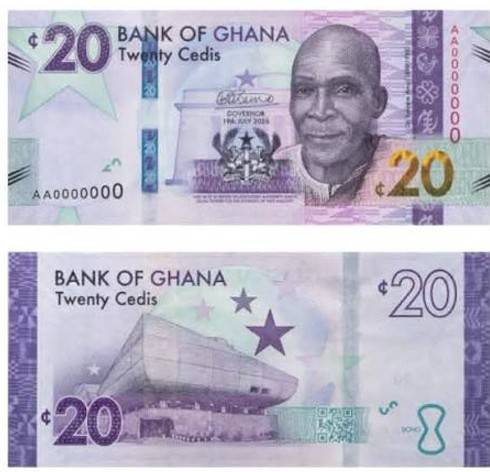
New GH¢20 Note
Legendary composer Dr Ephraim Amu is the face of the new GH¢20 note, after the Bank of Ghana unveiled its redesigned Heritage Series banknotes in Accra on Thursday, November 12, 2026. The new GH¢20 note, which carries the theme Arts and Entertainment, also features the National Theatre on its reverse side, putting Ghana’s creative industry at the centre of the country’s currency for the first time in more than two decades.
Quick Facts
- The Bank of Ghana unveiled eight redesigned Heritage Series cedi notes at Bank Square, Accra, on Thursday, November 12, 2026.
- The GH¢20 note carries the theme “Arts and Entertainment”, with Dr Ephraim Amu on the front and the National Theatre on the back.
- The GH¢50 note, themed “Nationalism”, honours Theodosia Salome Okoh, who designed Ghana’s national flag.
- The new notes go into circulation on Tuesday, December 1, 2026, alongside the existing notes, which remain legal tender.
- President John Dramani Mahama urged Ghanaians to “carry the Cedi with pride and uphold the confidence on which it rests.”
Watch: President Mahama Speaks at the Launch of the New Cedi Notes
JoyNews captured President Mahama’s remarks at the unveiling ceremony in Accra.
Ephraim Amu and the New GH¢20 Note
Each denomination in the Heritage Series represents a part of Ghana’s history, identity and achievements. The GH¢20 note was set aside for arts and entertainment, and the Bank of Ghana chose Dr Ephraim Amu, the composer and musician widely credited with shaping Ghana’s cultural identity through music.
According to GhanaWeb, Amu was born on September 13, 1899, at Avetile-Peki in the Volta Region. He attended primary school in Avetile and secondary school in Blengo.
The Composer Behind “Yɛn Ara Asase Ni”
Amu is best remembered for “Yɛn Ara Asase Ni”, the patriotic song that is still performed at state functions and school ceremonies across the country. The song also serves as the closing tune for several national events, and it has been reworked by a new generation of musicians, including the all-star version led by Kuami Eugene.
His other well-known works include “Adawura bɔ me” and “Asɛm yi di ka”. His music blended Western choral harmony with indigenous African rhythms, drum language and the speech melodies of Akan and Ewe.
The Kente Stand That Cost Him His Job
One of the most talked-about moments of Amu’s life came in 1933, when he was dismissed from the Presbyterian Training College at Akropong for preaching in kente cloth instead of a Western suit, GhanaWeb reported. Today, kente stoles are worn by clergy across many Christian denominations in Ghana and beyond.
Amu also helped revive traditional instruments such as the atenteben (bamboo flute) and the odurugya, bringing them into formal music education and orchestral works. He taught at Achimota School, the Kumasi College of Science and Technology and the Institute of African Studies at the University of Ghana. He died in his hometown in 1995.
National Theatre on the Back of the Note
The reverse of the new GH¢20 note shows the National Theatre in Accra, the country’s best-known performance venue. GhanaWeb noted that the building was completed in 1992 and has a 1,490-seat auditorium that hosts plays, concerts, dance recitals, film screenings, corporate meetings and community festivals.
The venue remains busy with entertainment events. Earlier this week, gospel singer Nacee paid tribute to the late Bernice Offei at the KAVOD 26 concert held there.
Theodosia Okoh Honoured on the GH¢50 Note
The GH¢50 note, themed “Nationalism”, honours Theodosia Salome Okoh, the woman credited with designing Ghana’s national flag. Her design was adopted when Ghana gained independence from Britain on March 6, 1957, under Dr Kwame Nkrumah.
Images of both sides of all eight notes were shared on Instagram by 3Xtra after the launch.
View this post on Instagram
Who Else Is on the New Cedi Notes?
According to YEN.com.gh, the full Heritage Series lines up as follows:
- GH¢1 (Commerce): Agnes Oforiwa Tagoe-Quarcoopome, a pioneering Accra market trader
- GH¢2 (Religious Freedom): Cardinal Peter Dery, with the Larabanga Mosque on the back
- GH¢5 (Education): Dr James Emman Kwegyir Aggrey, with Achimota School on the back
- GH¢10 (Justice and Equality): Justice Annie Jiagge, with the Supreme Court on the back
- GH¢100 (Peace): Kofi Annan, with the Kofi Annan International Peacekeeping Training Centre on the back
- GH¢200 (Sovereignty): Dr Kwame Nkrumah, with the Kwame Nkrumah Memorial Park on the back
What Mahama and the Bank of Ghana Said
Speaking at the launch, President Mahama said the cedi carries more than monetary value. “For the Ghanaian people, the Cedi has a very practical meaning. It pays for the food that appears on the family table,” he said, adding that it also carries “a sense of who we are and what we share as a nation.”
“Let us carry the Cedi with pride and uphold the confidence on which it rests,” the President told the gathering.
According to Africanews, Bank of Ghana Governor Johnson Asiama spoke about improved security features and durability, while the bank’s Director of Currency Management, Dominic Owusu, explained why the GH¢200 note has been made smaller. The central bank said the existing notes remain legal tender, so there is no need to rush to exchange them.
The public has also been urged not to write on the notes, crumple them or use them in money bouquets, an issue that previously led to arrests in Accra during a Bank of Ghana and police crackdown.
A Moment for Ghana’s Creative Industry
For musicians, actors and other creatives, seeing Ephraim Amu and the National Theatre on the GH¢20 note is a clear recognition of the role arts and entertainment play in the national story. The new notes will be in Ghanaians’ hands from December 1, 2026.
Also Read on Halmblog
- Yen Ara Asaase Ni by Kuami Eugene Ft All Stars
- Nacee Pays Emotional Tribute to Late Bernice Offei at KAVOD 26 Concert
- Seven Arrested in Accra as Bank of Ghana, Police Crack Down on Money Bouquets










Leave a Comment